
How to Tell if a Garage Door Installer Is Actually Local or Just a Lead-Gen Shell
How to Tell if a Garage Door Installer Is Actually Local or Just a Lead-Gen Shell
It’s 6:00 PM on a Tuesday. You’ve just finished a long day at work, and as you pull into your driveway and press the remote, you hear a violent, metallic bang. Your garage door jerks, stalls, and hangs at a dangerous angle. One of your torsion springs has snapped. In a minor panic, you pull out your smartphone and search for “garage door repair near me.” Within seconds, you see dozens of listings with five-star ratings and professional-looking logos. You click the first one that looks local, call the number, and a friendly voice says, “We’ll have a technician there in an hour.”
You feel a sense of relief. But what you don’t know is that the “company” you just called doesn’t actually exist in your town. They don’t own any trucks, they don’t employ any technicians, and their “local office” is actually a vacant lot or a UPS Store three towns over. You have just fallen into the trap of a “Lead-Gen Shell” – a predatory lead aggregator designed to look local while siphoning money from homeowners and selling your personal information to the highest bidder.
My name is Ken Martin, and I’ve spent over 30 years in the garage door and gate industry. As a former licensed contractor and IDEA Certified technician, I’ve seen the evolution of this industry from a handshake-based local trade to a digital battlefield. Today, I work as a consumer advocate because I’m tired of seeing homeowners get fleeced by companies that are invisible in local map packs for all the right reasons and visible for all the wrong ones. The “fake local” problem is an epidemic. In fact, CNBC has extensively reported on the “ghost listing” problem on Google Maps, where online volunteers are fighting a losing battle against thousands of fake business profiles created every day.
What is a Lead-Gen Shell?
To protect yourself, you first have to understand the mechanics of the scam. A lead-gen shell is not a garage door company; it is a marketing machine. These entities create hundreds, sometimes thousands, of fake Google Business Profiles (GBPs) across a wide geographic area. They use “ghost listings” – addresses that aren’t actually businesses – to trick Google’s algorithm into thinking they are a nearby service provider.
When you call the number on the listing, you aren’t reaching a local dispatcher. You are reaching a centralized call center, often located halfway across the country or even overseas. The call center then “sells” your lead to a subcontractor. In the industry, these leads are notorious for being priced from “high to astronomical.” On platforms like Reddit, industry insiders discuss paying anywhere from $100 to $200 just for the opportunity to talk to you.
Think about that for a moment: before the technician even starts their engine, they are $150 in the hole. To make a profit, they have to recoup that lead fee and their own overhead. This is why a simple residential garage door repair that should cost $250 often ends up costing $800 or $1,200 when a lead-gen shell is involved. The subcontractor is forced to overcharge you just to break even on the lead they bought.
Red Flag #1: The “Keyword-Stuffed” Business Name
Real businesses usually have real names. They are often named after families, local landmarks, or specific brand identities. Think “Smith & Sons Garage Doors” or “High Desert Door Systems.” These are brands built on brand trust signals that have been cultivated over years of service.
Lead-gen shells, however, name themselves based on what people type into search engines. If you see a company named “Best Garage Door Repair [Your City]” or “Emergency 24/7 Garage Door Services,” be extremely wary. These names are designed to capture “residential garage door repair” search traffic rather than build a long-term reputation. If the name of the company sounds like a search query rather than a business, it’s a major red flag. They aren’t interested in you remembering their name; they just want you to click the link.
Red Flag #2: The Ghost Address & Street View Test
One of the most effective ways to spot a shell is to look at their physical address. Because Google requires a physical address to show up in Map packs, lead-gen shells get creative. They use P.O. boxes, virtual offices (like Regus or WeWork), or even random residential addresses where the homeowner has no idea their house is being used as a “business.”
Here is the fix: drop the “Pegman” in Google Street View. If you look up a company claiming to be one of the top garage door repair companies in your area, and their address turns out to be a UPS Store, a vacant lot, or a suburban house with no signage and no trucks in the driveway, you are looking at a shell.
As a consumer advocate, I always tell people that real garage door repair companies will have a physical shop, a warehouse, or at least a clearly branded presence in the community. They aren’t hiding behind a mailbox at a strip mall. If you find that their online presence is generating fake map calls from a non-existent location, keep looking.
Red Flag #3: The $29 Bait-and-Switch
We’ve all seen the ads: “$29 Service Call!” or “$19 Tune-up Special!” It sounds like a bargain, especially when you’re worried about a big repair bill. However, this is the primary “foot-in-the-door” technique used by aggregators and their unvetted subcontractors.
The Overhead Door company blog has warned consumers for years about these low-priced service call promises. Here is how the math works: No legitimate company can afford to send a trained technician, a fully stocked truck, and pay for fuel and insurance for $29. It’s a mathematical impossibility. The $29 is simply the fee to get the “technician” (who is often an untrained subcontractor) into your garage. Once they arrive, they will perform a “safety inspection” and miraculously find $1,000 worth of “urgent” repairs. They rely on the fact that you’ve already paid the $29 and just want your door fixed so you can go about your day. This predatory pricing is the hallmark of a lead-gen operation.
Red Flag #4: Review Manipulation & The “Wave” Effect
In the digital age, we rely on reviews. Unfortunately, lead-gen shells know this and buy reviews in bulk from “click farms.” To spot these, you need to look for the “Wave Effect.”
A real local business will have a steady stream of reviews over several years. A lead-gen shell will often have 50 or 100 reviews all appearing within a single week, followed by months of total silence. This is a sign that they purchased a “reputation package” to boost their ranking. Furthermore, look at the content of the reviews. Are they generic? “Great job!” or “Very fast!” without mentioning specific technicians by name or local landmarks? Real garage door installers get reviews that mention things like, “Dave was great, he even helped me program my car’s HomeLink!” Fake reviews are rarely that specific.
When searching for garage door installers, always sort reviews by “Newest” and look for consistency. If you see a sudden burst of activity followed by a “ghost town” profile, move on to the next company.
The “Boots on the Ground” Verification
Even if you’ve already booked the appointment, you can still verify the company before they touch your door. Real local pros invest in their branding because they plan to be in business for the next 20 years. They want you to see their truck in the neighborhood and remember their name.
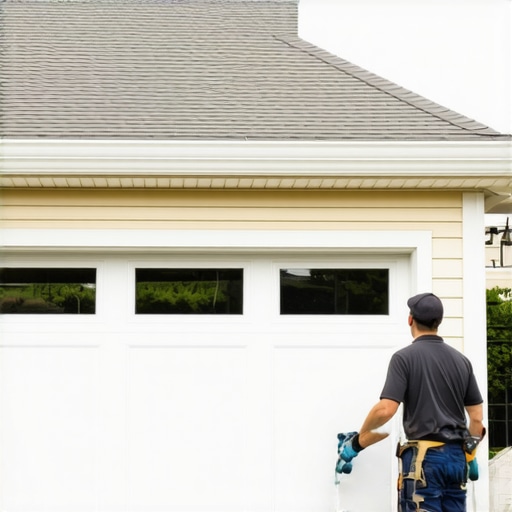
- Uniforms & Trucks: If a technician arrives in an unmarked white van or a beat-up personal SUV with no magnetic signs, and they are wearing a plain t-shirt with no company logo, they are likely a “shell” subcontractor.
- Phone Etiquette: When you call, how do they answer? A real company answers with their name: “Thanks for calling Southwest Doors and Gates.” A lead-gen shell call center will often answer with a generic greeting like “Garage Doors” or “Service Department” because they are answering calls for 50 different “ghost” companies at once.
- Licensing & Certification: Ask for proof of licensing. As an IDEA Certified technician, I know that legitimate professionals carry their credentials with them. If they can’t show you a local business license or proof of insurance, do not let them touch your garage door.
The importance of human-verified authors and technicians cannot be overstated in an industry where safety is the top priority. You are letting a stranger into your home; you deserve to know exactly who they work for.
Why This Matters: Safety and Warranty
You might think, “As long as the door gets fixed, why does it matter if the company is a shell?” It matters because of two critical factors: safety and accountability.
Garage doors are the largest moving objects in most homes. They operate under immense spring tension that can be lethal if mishandled. Lead-gen shells often hire whoever is available, regardless of training. If a shell company performs a garage door installation and the door falls off the tracks a month later because it wasn’t balanced correctly, who do you call? The “company” you originally called may no longer exist, or they will claim the subcontractor is responsible. The subcontractor, meanwhile, has moved on to the next lead and has no interest in honoring a warranty for a job they were underpaid for.
Furthermore, there is the issue of liability. If an unvetted, uninsured subcontractor gets injured on your property, you – the homeowner – could be held liable for their medical expenses. Real local companies carry workers’ compensation and general liability insurance to protect both their employees and their customers.
Conclusion: How to Hire a Real Local Pro
Your home’s security and your family’s safety depend on who you let into your garage. Don’t let the stress of a broken door lead you into a financial trap. It is vital to verify your brand entity before you sign any contracts or authorize any work. By doing just five minutes of research, you can save yourself hundreds of dollars and a massive headache.
Your Verification Checklist:
- Verify the physical address: Use Google Street View to ensure it’s a real place of business, not a P.O. Box or a vacant lot.
- Check the BBB: Look for the Better Business Bureau listing and ensure the phone number and address match what is on their website.
- Ask for a Name: When you call, ask, “What is the name of the company I am speaking with?” If they hesitate or give a generic answer, hang up.
- Watch for the “Too Good to be True” price: Avoid any company offering service calls for under $50. It is almost always a bait-and-switch.
- Demand Credentials: Ask the technician for their ID and proof of insurance the moment they arrive.
As a consumer advocate, I help homeowners resolve conflicts with safety and reliability. The first step is knowing exactly who is at your door. Stay vigilant, do your homework, and support the real local businesses that actually live and work in your community.